Automatic Agentic Workflow Generation
& The evolution of Agentic workflows

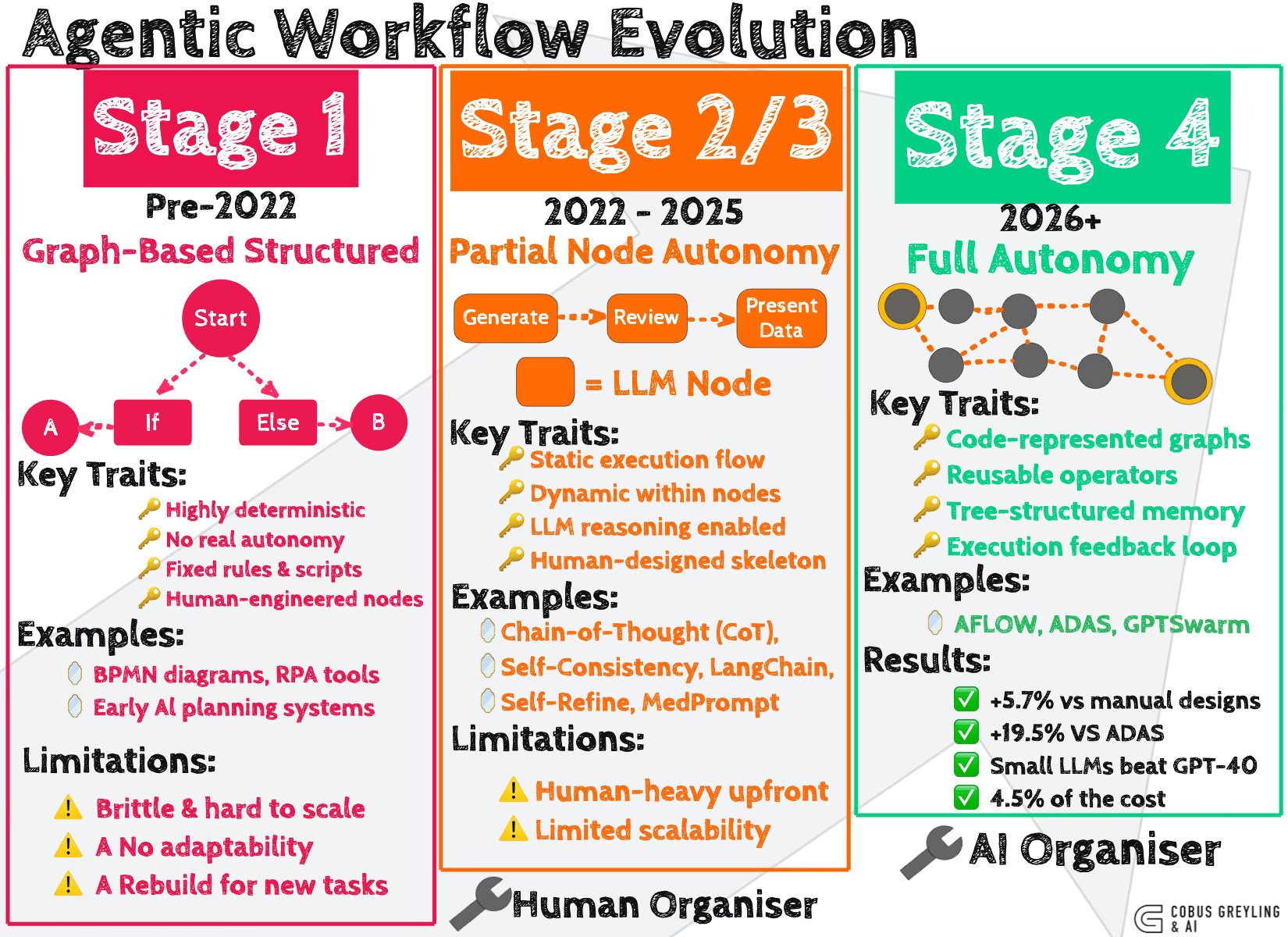
Stage 1 began with rigid graph-based structures featuring fixed decision nodes, where human-engineered rules dictated every path without adaptability, as seen in early systems like chatbot dialog flows and traditional RPA for process modelling.
Stage 2 introduced AI Agents, enabling dynamic, autonomous decision-making with ability to reason and act. By decomposing complex and compound queries into sequential sub-seps. This was all the rage only a few months ago.
And touted as the last stop on the journey of agency…this changed quite quickly, due to various reasons…
Advancing to Stage 3, agentic workflows emerged (we are here), blending human-crafted sequences (edges) with LLM-based lightweight AI Agent invocations (nodes).
Nodes gained autonomy — with predefined edges…
Finally, Stage 4 realises automated flow generation, exemplified by frameworks like AFLOW, which use Tree Search to explore optimised workflows for tasks.
Iteratively discovering and reusing optimal structures via LLM-driven expansion and feedback, outperforming manual designs by 5.7%.
There is also an element of saving time and effort in creating flows in a hand crafted fashion.
Looking at the evolution in more detail…
Stage 1
Graph-Based Structures with Fixed Decision Nodes (Pre-LLM Era, ~2010s)
This foundational phase relied on explicit, human-engineered graphs or decision trees where nodes were hardcoded rules or simple functions (chatbots, Conversational UIs, RPA).
No AI — just deterministic paths for tasks like process automation or basic conversation dialog flow.
Key Traits
Fully static and brittle
Nodes lacked any learning or variability.
Execution followed fixed edges (sequences, branches) without feedback loops.
Examples
Early robotic pathfinding or business workflow tools, chatbot development frameworks.
Limitations
Inflexible for complex,
uncertain environments;
required manual rewiring for every new task, leading to scalability issues.
Transition trigger
Rise of ML models enabled smarter nodes, but graphs remained too rigid for open-ended problems.
Stage 2
AI Agents (Early LLM Era, ~2022–Early 2024)
Here, systems shifted to autonomous agents — standalone AI entities that operate dynamically in environments, making real-time decisions via tools, memory and planning.
Unlike stage 1’s fixed nodes, agents use LLMs for on-the-fly reasoning (reasoning and acting).
But they’re often single-loop (observe-act-reflect) without predefined multi-step orchestration.
Key Traits
Flexible and reactive
AI Agents perceive states, select actions (for example, via ReAct prompting) and adapt via short-term memory or external tools.
Human role: Define the agent’s toolkit and high-level goals, but execution is emergent.
Examples
Early tools like Auto-GPT or BabyAGI, where an agent iteratively queries APIs, debugs code, or explores web data autonomously.
For example, solving a research task by chaining web searches and summaries.
Per the AFLOW paper, these emphasise flexible autonomous decision-making tailored to environments.
Strengths/Limitations
Great for exploratory tasks
but prone to hallucination loops or inefficiency in structured domains;
Lacks reusable, scalable pipelines across tasks.
Limitations include latency, accuracy for long running tasks.
Cost / benefit / accuracy tradeoff.
Transition Trigger
Need for reliability in repetitive/complex workflows led to composing agents into chains, blending autonomy with structure.
Stage 3
Agentic Workflows (Mid-LLM Era, ~2023–2025)
This stage hybridises stage 2’s agentic nodes with human-designed flows.
Workflows become multi-agent pipelines where humans craft the overall structure (edges like sequences or conditionals), but individual nodes are autonomous agents (LLM invocations with prompts for reasoning).
Execution is static — follow the blueprint — but nodes inject dynamism.
Key Traits
Predefined sequences of agent calls
For example, Agent A generates, Agent B reviews leveraging domain expertise for edges.
Nodes handle variability, enabling transfer across tasks.
Examples
LangChain/LlamaIndex pipelines for code generation or math solving.
The AFLOW paper highlights general vs. domain-specific variants, all manually iterated.
Strengths/Limitations
More reliable and scalable than pure agents
but human effort in design/refinement limits generalisation
Transition trigger
The “significant human effort” bottleneck (as noted in AFLOW) spurred meta-optimisation
Turning workflow design into an AI-solvable search problem.
Stage 4
Automated Flow Generation (Late LLM Era, 2026+)
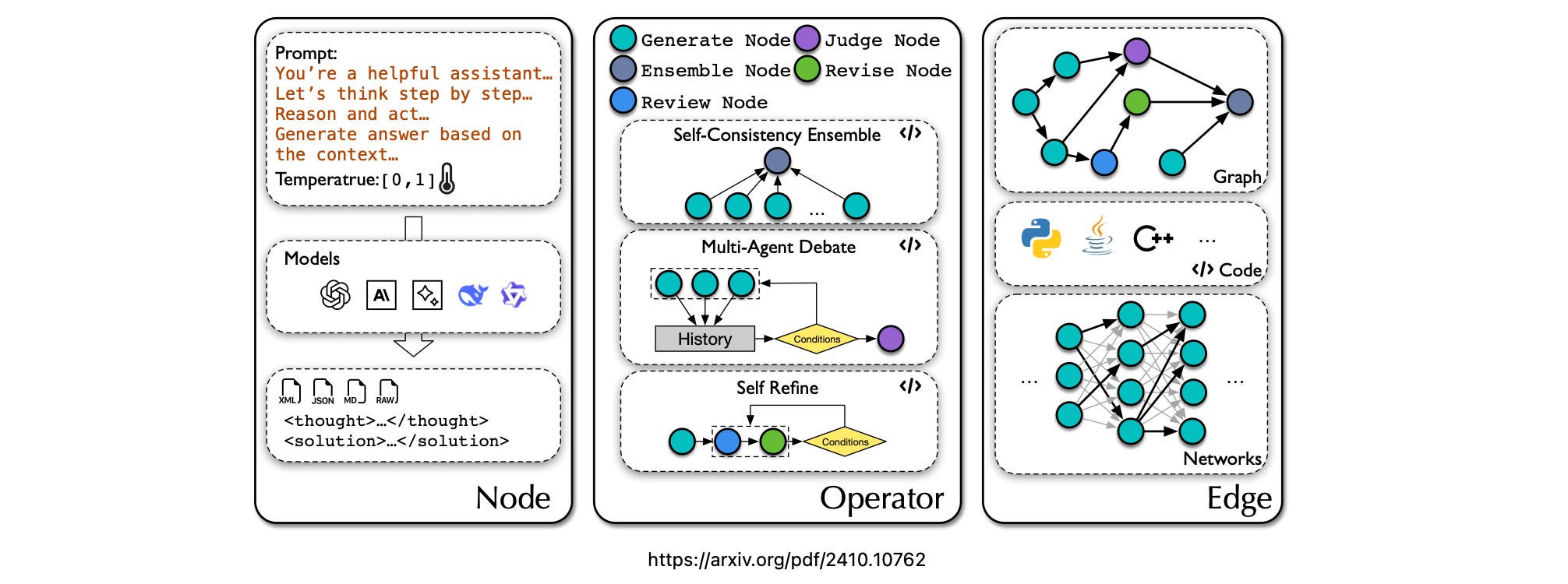
Now, AI takes the wheel…frameworks auto-discover and optimise entire workflows as a search over nodes (agents) and edges (logic/code), mapping optimal configs.
Then reusing them as reusable templates.
Humans provide only task specs and eval functions; the rest emerges from exploration-feedback loops.
Key Traits
Treats workflows as code-represented graphs;
Uses tree search ( soft selection, LLM expansion) to evolve structures, back propagating experiences for efficiency.
Outputs are “plug-and-play” pipelines, often outperforming manual ones.
Examples
AFLOW auto-generates for benchmarks like HumanEval (+5.7% over manuals, +19.5% over priors),
Enabling small Language Models to beat GPT-4o at 4.55% cost.
Strengths/Limitations
Minimizes intervention
Boosts cross-domain transfer; still compute-heavy, but trending toward zero-shot via larger operator libraries.
Implications/Future
This meta-automation unlocks workflow markets
Paving for stage 5: Self-evolving ecosystems where flows adapt live via online learning.
This four-stage arc shows a clear trajectory toward autonomy at every level — from nodes, to flows, to their invention.
This evolution reflects a push toward meta-automation: not just smarter agents, but systems that build better agents.
Chief Evangelist @ Kore.ai | I’m passionate about exploring the intersection of AI and language. Language Models, AI Agents, Agentic Apps, Dev Frameworks & Data-Driven Tools shaping tomorrow.
AFlow: Automating Agentic Workflow Generation
Large language models (LLMs) have demonstrated remarkable potential in solving complex tasks across diverse domains…arxiv.org
COBUS GREYLING
Where AI Meets Language | Language Models, AI Agents, Agentic Applications, Development Frameworks & Data-Centric…cobusgreyling.me