Everything is Context
A Virtual File System (VFS) unifies AI Agent context management by treating all elements as files.

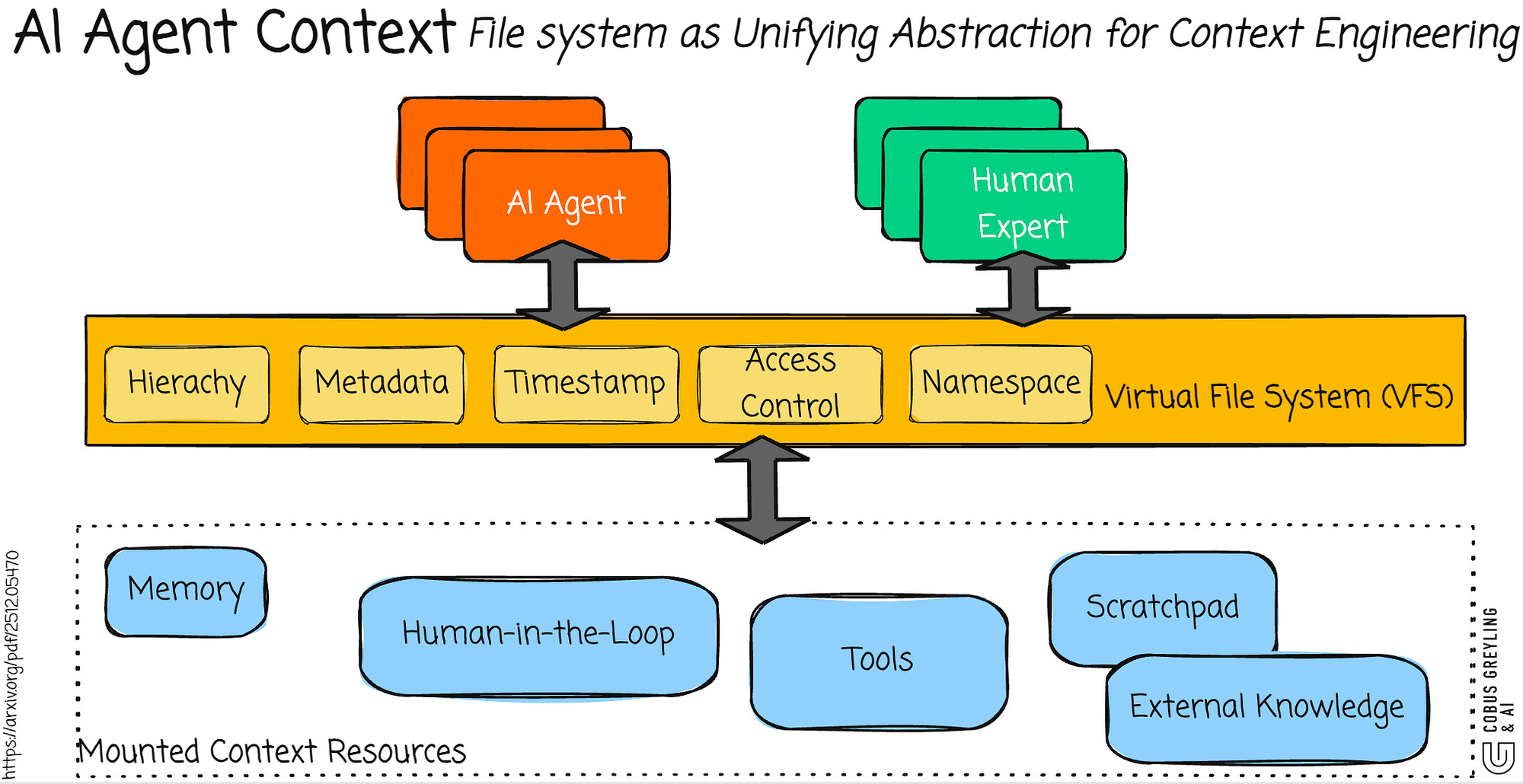
The emerging challenge is no longer model fine-tuning but context engineering — how systems capture, structure and govern external knowledge, memory, tools and human input…to enable trustworthy & contextual reasoning.
AI Agents handle dynamic, long-running interactions that generate vast context data, including history, memory and transient states.
Current approaches fragment this data across disparate structures, complicating capture, updates and debugging.
A unified abstraction simplifies these processes without sacrificing flexibility.
The central idea of this research is a “File system for AI Agents.”
I need to start off by saying not all solutions or ideas need to be implemented.
But, research and prototyping allows for new ideas and perspectives. And I find that my understanding evolves quite a bit as I look at how others are thinking about things.
As I have mentioned before, over the recent past when it comes to sub-components of AI Agents, the focus has been shifting to context and memory.
And currently the focus is on context and architectural approaches are unfolding.
But keep in mind the challenge is to prioritise the use-case and what needs to be achieved within an organisation. And fashioning technology around it.
Inspired by the Unix notion that “everything is a file”.
The Shift to Context Engineering
Traditional AI development emphasised training models on vast datasets.
But with foundation models like LLMs (Large Language Models), the game has changed.
Models can be considered as pre-trained sub-systems with fixed architectures, including limited token windows that constrain how much information they can process at once.
Prompt engineering — crafting clever instructions — is giving way to context engineering, a holistic process that manages the entire information lifecycle.
This paper highlights this pivot.
Context engineering is a structured process where:
Agents first write contextual information into a shared memory or store.
Select the most relevant elements for a given task.
Compress the selected context to fit model constraints.
Isolate the final subset across agents for reasoning.
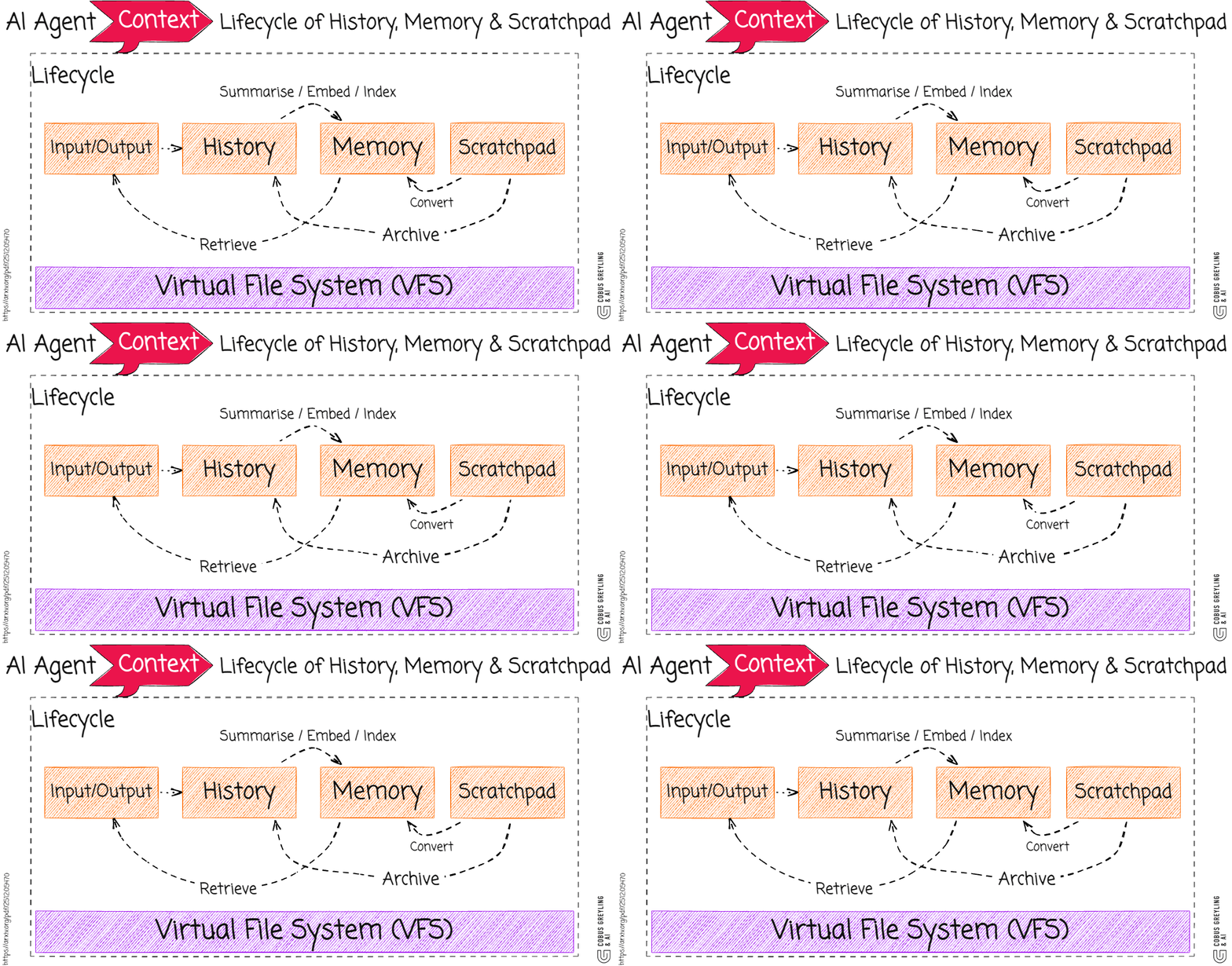
This pipeline ensures AI systems remain coherent, efficient and verifiable.
The paper proposes a file-system abstraction as the foundation for this.
Drawing from Unix’s philosophy, it treats heterogeneous sources — memory stores, tools, knowledge graphs, human inputs — as files in a persistent, hierarchical environment.
This isn’t just metaphorical; it’s a software architecture that enables mounting, metadata management, and access control for scalable coordination.
Filesystems solve ‘what information exists and how to organise it.’
But, they don’t solve ‘what does this human actually want and how do they work.’
That’s where human-AI co-work works well.
Humans act as curators, verifiers and co-reasoners, embedding tacit knowledge into the system.
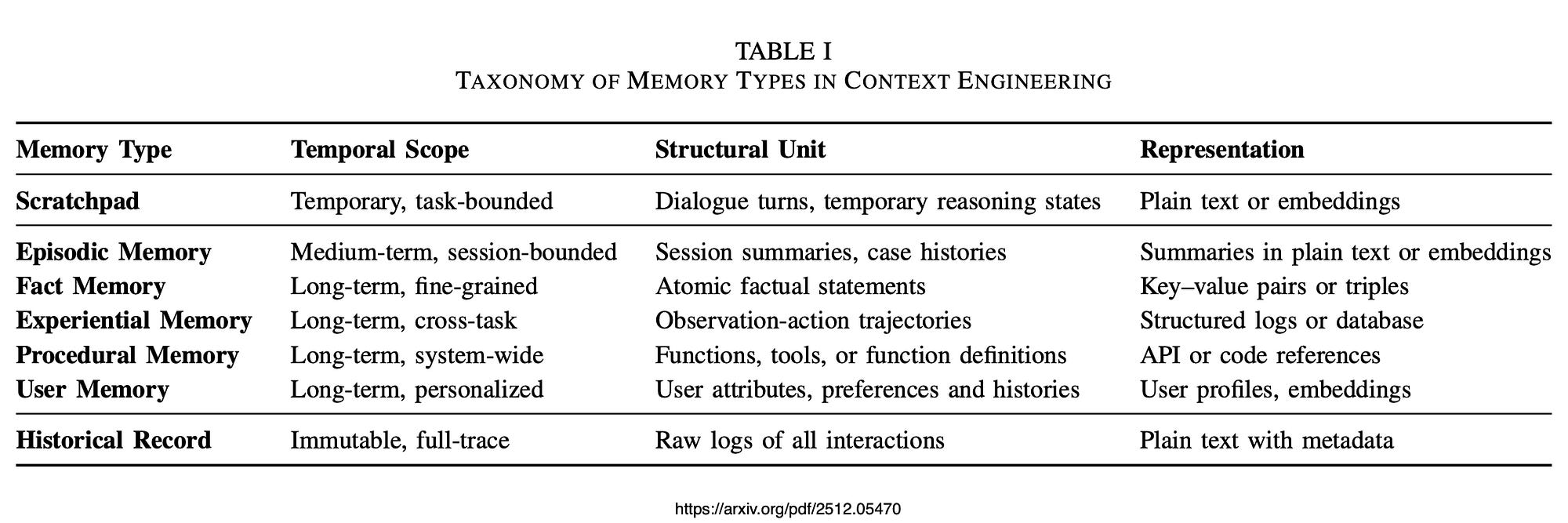
Sone key components:
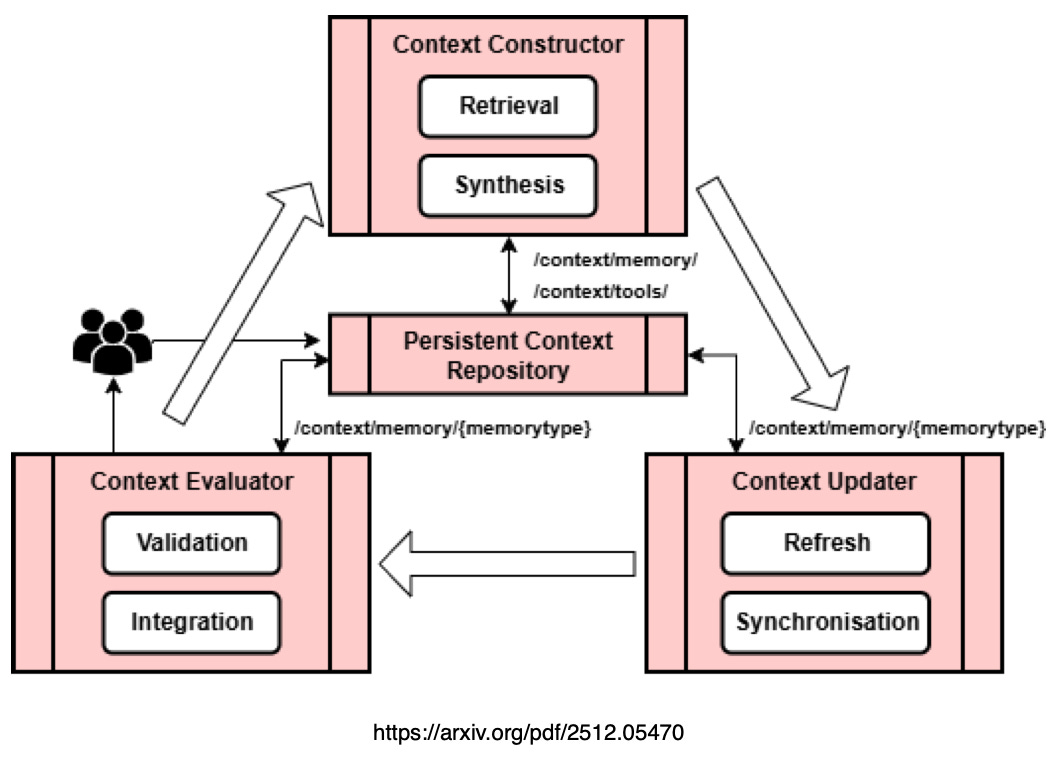
Context Constructor
Selects, prioritises and compresses context from the repository, generating a traceable manifest.
Context Updater
Streams context incrementally into the model’s window, refreshing as needed.
Context Evaluator
Verifies outputs, detects hallucinations and reintegrates validated info, often with human review.
The components form a closed loop, addressing bounded reasoning while maintaining traceability.
Finally…
As Generative AI integrates into domains like healthcare and decision support, trustworthy reasoning demands robust context management.
The file-system approach transforms ad-hoc practices into a reusable infrastructure, where AI Agents evolve their own world models in a human-aligned way.
So I like the idea of AI Agent Context becoming true infrastructure.
And the fact that innovation often build on timeless ideas — like Unix’s file philosophy — to tackle modern problems.
As memory takes centre stage in Agentic AI, prioritising context engineering will define how we scale intelligent systems responsibly.

Chief Evangelist @ Kore.ai | I’m passionate about exploring the intersection of AI and language. Language Models, AI Agents, Agentic Apps, Dev Frameworks & Data-Driven Tools shaping tomorrow.
