Fleet Engineering
LangSmith Fleet names the problem every enterprise is about to have…not one agent, but a fleet of agents…

Six months ago, building an agent required an engineer.
Today, a knowledge worker describes a task in a short prompt and gets a working agent back, or a whole swarm for that matter.
Of course there is a difference between the initial concepts of agents which was more hand crafted and now we have the automatic spawning of multiple agents which currently happens. But the principle remains that it is becoming easier.
I think LangChain’s own framing on the LangSmith Fleet page captures the shift cleanly…that agent creation got easy and fast.
So I guess the need for managing agents is that teams start with one or two agents….agents for research, status checks, inbox triage.
Then use cases multiply and within a quarter, you do not have an agent but you have a fleet of agents..
The question is no longer “can we build this?” But rather “who owns it, how does it authenticate, who can audit what it did, and how do we share a good one without breaking it?”
That is fleet engineering, the discipline of operating many agents across an organisation with the same rigour we already expect from production software.
The progression
LangChain describes a pattern they have watched repeatedly since launching Agent Builder in October 2025. I have seen the same arc in enterprise conversations….
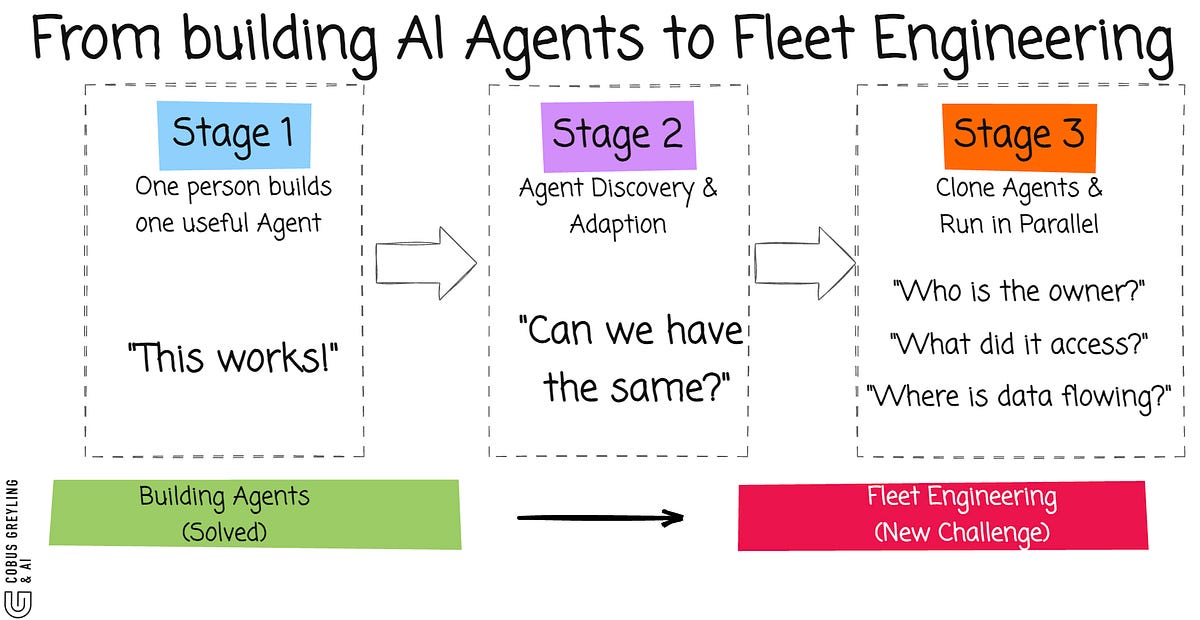
Stage three is not a tooling problem, but rather a governance, identity and observability problem. Fleet engineering is what you need when agent creation is democratised but agent operation is not.
LangSmith Fleet framework
LangSmith Fleet organises the answer around four capabilities…
Delegate, Improve, Approve, Connect, plus an organisational layer for scaling across the whole company.
Delegate
Describe a task, fleet makes a plan and takes action across the apps your team already uses…Salesforce, Gmail, Slack, GitHub, BigQuery.
Turn any chat into a reusable agent with one click. This is the creation surface, now aimed at knowledge workers rather than engineers.
Improve
Agents get better through use, not just through prompt rewrites. Fleet incorporates memory and teammate-style feedback so corrections persist.
Every run is also traced in LangSmith, which means improvement is grounded in what the agent actually did , not what you hoped it did.
Approve
Sensitive actions get tool-level approval requirements. Humans stay in the loop where it matters. A centralised Agent Inbox lets you review, edit and approve actions across agents without tab-hopping.
This is the production pattern I keep writing about: short autonomous chains, human checkpoints at the blast-radius boundaries.
Connect
First-party integrations with OAuth for user authentication. Remote MCP servers for extending capabilities.
Admins control which tools are available. The harness is not a free-for-all , it is a governed tool surface.
Above those four pillars sits the organisational layer:
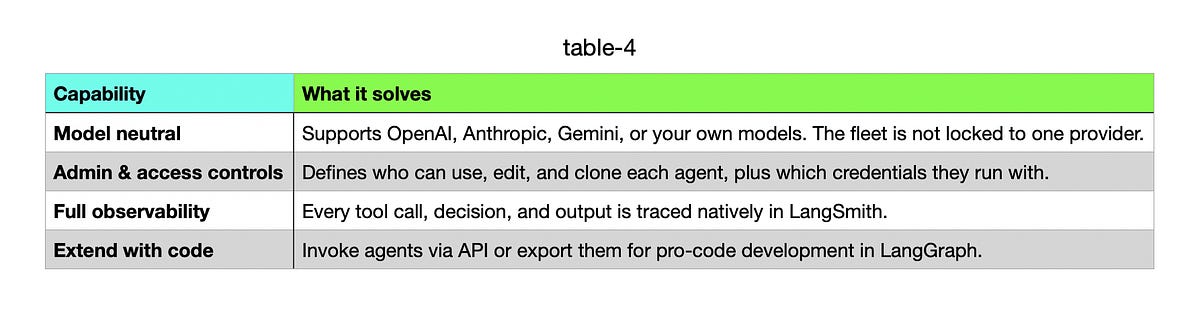
That last row is important, fleet is not a no-code island. Engineering teams can prototype in the workspace and productionise in code while retaining the same audit trail.
The fleet stack
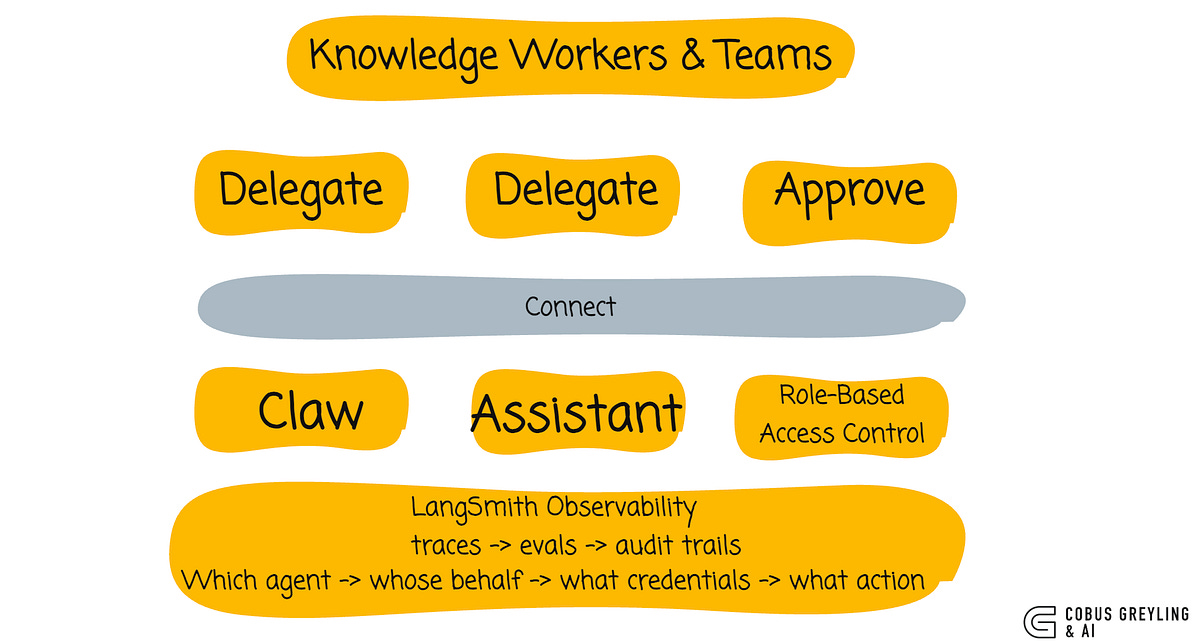
Observability is the floor, not an add-on, without structured traces, fleet engineering collapses into trust-me demos. LangSmith Fleet makes every run inspectable by construction.
The Claw vs Assistant split is the identity decision most teams underestimate.
Claws have seemingly been the default in Fleet. They’re ideal when you want consistent behavior and permissions regardless of who is using the agent.
A Claw uses fixed credentials. An Assistant acts on behalf of the invoking user via OAuth. Get this wrong and you either over-expose data or under-deliver utility.
Lastly
The model is rented, unless it is self hosted (to some degree) and open weights…meaning that is good to be model agnostic.
Even the harness is owned…at organisational scale, the fleet is owned also and it (should) outlasts any single model swap.
LangSmith Fleet does not solve agent intelligence. It solves agent operations, the layer that determines whether ten agents across your company are a productivity multiplier or an ungoverned liability.
We spent 2024–2025 learning to build agents.
2026 is the year we learn to run them like a fleet…delegated work, governed tools, human approval at the edges and observability underneath everything.
Chief Evangelist @ Kore.ai | I’m passionate about exploring the intersection of AI and language. From Language Models, AI Agents to Agentic Applications, Development Frameworks & Data-Centric Productivity Tools, I share insights and ideas on how these technologies are shaping the future.
Fleet
LangSmith Fleet enables anyone to build powerful agents using natural language.www.langchain.com
COBUS GREYLING - At the intersection of AI & Language
Cobus Greyling is an AI Evangelist & thought leader dedicated to exploring the intersection of artificial intelligence…www.cobusgreyling.com
GitHub - cobusgreyling/fleet-engineering: Practical reference for fleet engineering, governing…
Practical reference for fleet engineering, governing populations of AI agents with accountability …github.com