Grok Voice Agent Builder
What it is good for and not so good at…

In Short:
A key strength of modern AI agents is their ability to engage in natural voice conversations while seamlessly navigating digital environments, such as browsing the web, using tools, and taking action in real time.
This aligns with Elon Musk’s vision that AI agents will eventually match the capabilities of human agents.
I’m wondering whether building voice agents should be approached more like building a website…or with the same mindset.
The flow management is defined in Markdown and feels somewhat lightweight, with most of the flow management offloaded to the model’s reasoning capabilities.
It lacks the granularity found in OpenAI’s Flow Builder, which uses a graph-based approach to building agentic workflows.
There may also be challenges around regional and geographic representation, as the solution does not appear to be strongly focused on the US market.
The big promises are compelling: build a voice agent in 2 minutes, achieve sub-second latency, support for 25+ languages, all at a cost of just $0.05 per minute.
I guess there is a case to be made for instances where a high level of granularity and control are required…especially for enterprise use-cases where a high degree of access is required in terms of AI primitives to build with.
I have the sense that organisations will outgrow the Grok Voice Agent Builder in no time as their application needs grow…
So the ideal will be for Grok to grow their product into something more substantial.
There is also the element of companies wanting to develop their own harness. And become model independent / agnostic.
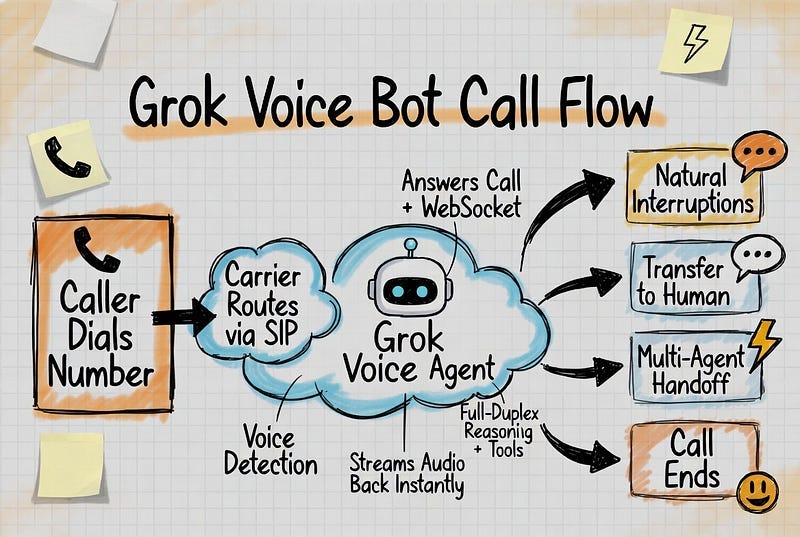
Call Flows
A big consideration with Grok voice agents is that the flow building and defining is only done on a high level.
Simple version:
You are a friendly support agent for my AI consulting business. Greet callers warmly, ask for their name and inquiry, answer questions using my uploaded docs, book discovery calls in Google Calendar if they seem qualified, and offer to send a follow-up summary email. Always stay professional but conversational. If unsure, offer to transfer to me. Structured version:
## Greeting
Welcome warmly and ask how I can help today.

## Handling Inquiries
Use the knowledge base to answer questions about my services, pricing, and past work.

## Booking
If the caller wants a meeting, check availability and book in Google Calendar.

## Wrap-up
Recap the conversation and confirm next steps.
The reasoning and flow capacity is managed by the reasoning capabilities of the model.
Telephony
Every xAI account gets one free provisioned phone number (US number in beta). Assign it directly to your agent in the console.
Additional numbers or high volume: you pay about $0.01/min extra for xAI-provisioned telephony.
Direct SIP trunking support for existing numbers from major providers (Twilio, Telnyx, etc.).
Escalation
When situations require human expertise, they can intelligently escalate by transferring the call to a team member, providing a clear summary of the conversation so the handoff feels smooth and contextual rather than abrupt.
In your instructions, clearly describe when to transfer (e.g., “If the caller requests a human, the issue is complex/sensitive, outside policy, or the caller is frustrated…”).
The agent calls the transfer tool (with optional parameters like reason and summary for context).
The system performs a warm transfer (via SIP REFER or equivalent) — the caller is moved to the target without dropping the call.
Real-time notifications (e.g., Slack, email, or your system) are sent with transcript summary so the human is briefed.
Integration
Via MCP integration, and tools for example:
{
  “type”: “function”,
  “function”: {
    “name”: “check_order_status”,
    “description”: “Retrieve the current status of a customer order”,
    “parameters”: {
      “type”: “object”,
      “properties”: {
        “order_id”: { “type”: “string”, “description”: “The customer’s order number” }
      },
      “required”: [”order_id”]
    }
  }
}Some background
xAI’s new Grok Voice Agent Builder makes this vision practical and accessible.
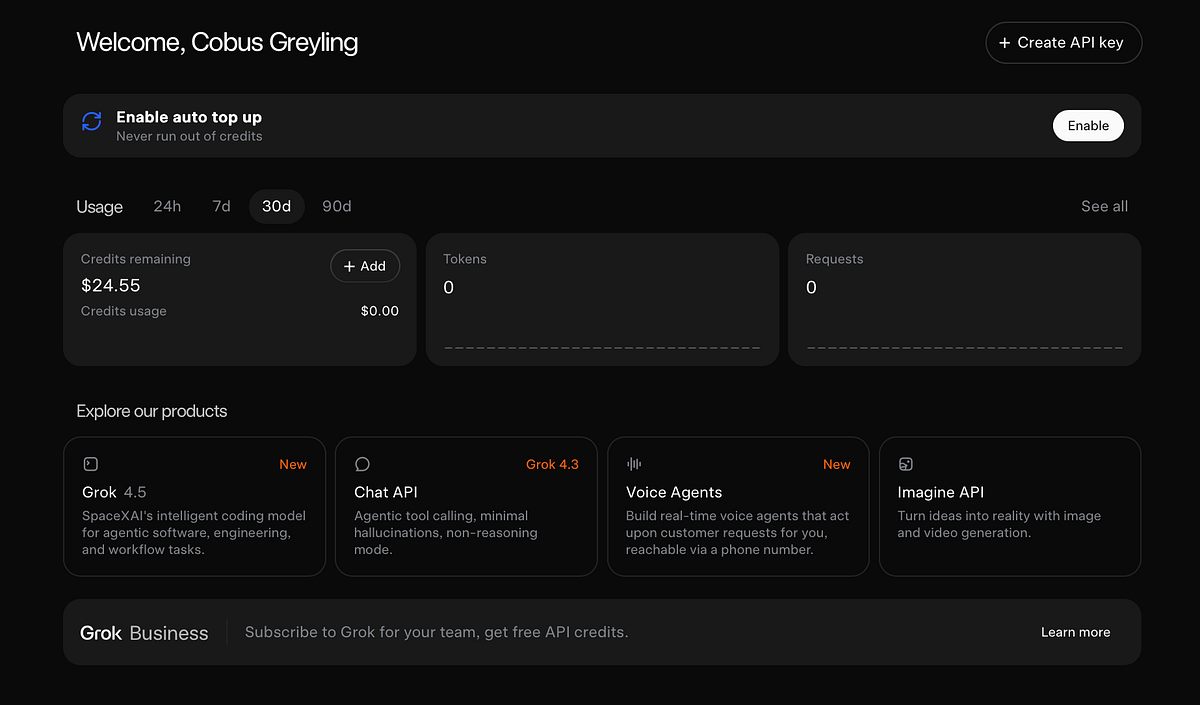
It delivers production-ready voice agents powered by Grok Voice in a no-code platform, allowing anyone to create sophisticated agents that handle real phone calls while acting intelligently in the digital world.
More on the Voice Agent Builder
Voice Agent Builder is a no-code platform for building high-volume production voice agents with Grok Voice. Every account includes a free phone number to get started quickly…you can create and deploy an agent in under 2 minutes, then test it directly from your browser.
It’s designed for operators and developers who want robust voice agents without stitching together a full stack from scratch.
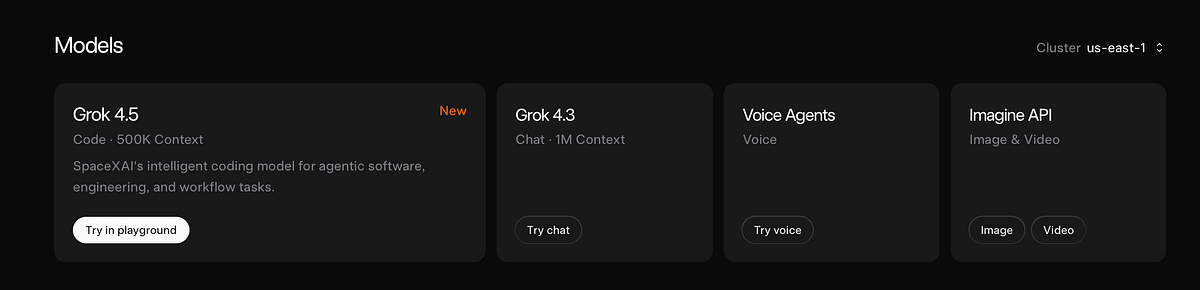
You get telephony, knowledge retrieval (RAG), tools/connectors, guardrails, multi-agent transfers, and full observability in one unified interface.
For flexibility, you can bring your existing phone numbers (via SIP), wire in your own APIs, connect custom MCP (Model Context Protocol) servers, or integrate with your preferred clients over WebSocket.
Traditional voice stacks often combine separate speech-to-text (STT), large language model (LLM), and text-to-speech (TTS) services from different providers.
Each hop introduces latency, extra costs, and failure points. Grok Voice Agent Builder uses a tightly integrated, end-to-end speech-to-speech model (Grok Voice Think Fast 1.0) built from the ground up by xAI.
This delivers sub-second responses (often under 700ms in tests), handles interruptions, accents, noisy calls, and complex workflows far more naturally.
Recent updates include 21 new flagship voices (tailored for support, sales, etc.), agent-to-agent transfers (with context preservation), new tools like web search and X search, custom MCPs, connectors (e.g., HubSpot, SharePoint), and speech controls for pronunciation, speed, and silence follow-ups.
How Voice Agents work
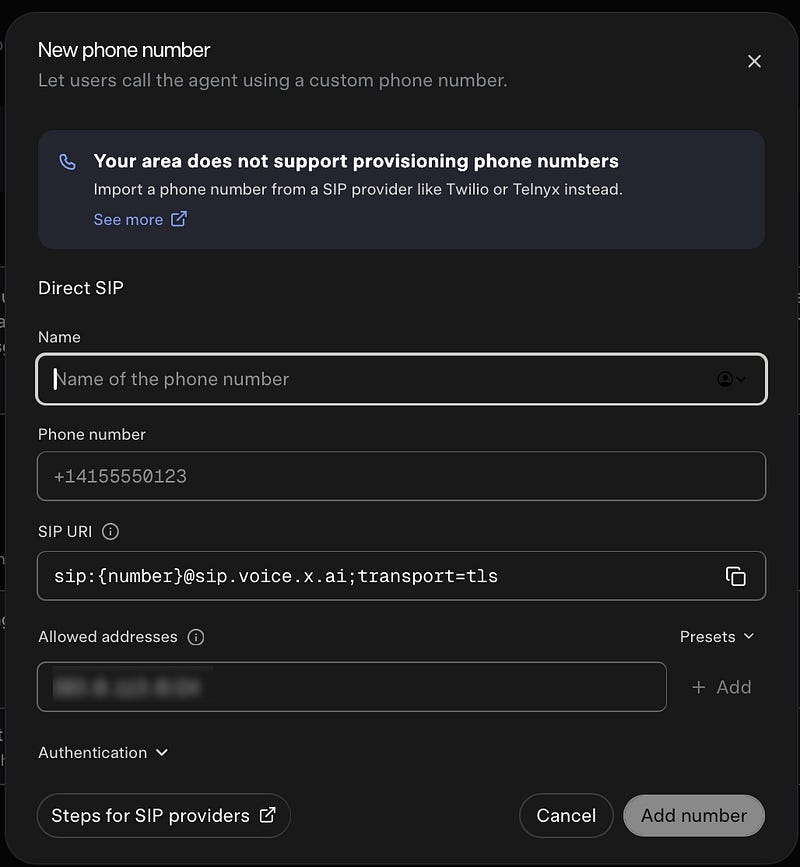
Deploying a voice agent to real phone lines involves bridging the AI brain with the public telephone network (PSTN). Here’s a practical breakdown tailored to Grok Voice Agent Builder:
Phone Numbers: Every account gets a free provisioned US phone number for immediate testing and low-volume use. This handles inbound calls out of the box.
For production or international needs, you can port or bring your existing numbers.
SIP (Session Initiation Protocol): This is the standard for connecting your existing telephony infrastructure. Grok supports direct SIP trunking, allowing you to route calls from major providers to your agent seamlessly. SIP handles call setup (INVITE), media negotiation (via SDP), and teardown. Your agent receives audio streams (often via RTP or WebSocket media streams) in real time, processes them, and sends synthesized speech back. This avoids vendor lock-in and supports high-volume, enterprise-grade reliability.
Reserving/Provisioning Numbers: Provisioning is straightforward in the console — xAI handles the carrier-side details for free numbers. For custom setups, you configure SIP trunks or inbound routing rules. Calls hit the telephony layer first (PSTN → carrier/SIP trunk → Grok’s media handling), then stream audio to the speech-to-speech model. No complex media servers needed on your end unless you’re self-hosting deeply.
This setup minimises latency compared to multi-hop stacks. For high concurrency, the platform scales automatically — handle dozens of simultaneous calls without spinning up separate instances.
Pricing practicality: Billed simply at ~$0.05 per minute of audio (voices included, no separate platform fee). Telephony on provisioned numbers adds ~$0.01/min. Additional costs apply for storage, certain tool calls (e.g., search), etc. Transparent and usage-based — ideal for testing before scaling.
Building Your First Agent: Step-by-Step Practical Guide
Log in to the console (console.x.ai/voice/agents) and start a new agent.
Describe the playbook in plain language: e.g., “Welcome callers, ask for their order number, look it up, resolve issues, book follow-ups if needed, transfer to human for escalations.”
Upload knowledge: Add documents (PDFs, Word, Excel, Markdown, etc.) to collections for RAG retrieval during calls. Share collections across agents.
Add tools & MCPs: Connect Google Calendar/Outlook, Gmail, Linear, Notion, Drive, web/X search, custom APIs, or existing MCP servers. Agents can act (e.g., update records, send confirmations) mid-call.
Choose voice & controls: Pick from 80+ built-in voices (including the new ones) or clone your brand’s voice from ~2 minutes of audio. Adjust speed, pronunciation, silence handling.
Assign number & test: Use the free number or SIP. Preview/test in-browser instantly. Deploy and monitor calls (recordings, transcripts, tool traces, analytics).
Guardrails & observability: Define rules (e.g., no sharing PII) and review every interaction.
Agents support 25+ languages with mid-call switching and handle messy real-world calls exceptionally well (trained on challenging telephony audio).

Use Cases
Customer Service/Support: Infinitely patient handling of complaints, order lookups, refund…directly tying into Musk’s SpaceX vision.
Sales & Scheduling: Qualify leads, book meetings, pull CRM data in real time.
Internal Ops: Employee assistance, ticketing, knowledge access.
Chief Evangelist @ Kore.ai | I’m passionate about exploring the intersection of AI and language. From Language Models, AI Agents to Agentic Applications, Development Frameworks & Data-Centric Productivity Tools, I share insights and ideas on how these technologies are shaping the future.
xAI - Creators of Grok, the AI Chatbot
Create your own voice agent in under 2 minutes. Deploy human-like voice agents for customer support, sales, and more …x.ai
COBUS GREYLING - At the intersection of AI & Language
Cobus Greyling is an AI Evangelist & thought leader dedicated to exploring the intersection of artificial intelligence…www.cobusgreyling.com