
Recently I wrote that the proxy layer in front of the model is becoming the intelligence layer. And that a number companies like NVIDIA, Stripe (OpenRouter), HuggingFace etc. are focusing on this layer.
A few days ago I discovered research Cursor has put into routing models and optimising by matching the right task to the right model. They launched something they call Cursor Router.
In short, Cursor Router allows teams to automatically route every request to the most capable model for the task. Effectively matching tasks to models according to how demanding the task is.
Customers get frontier performance at approximately 30–50% lower cost. ~ Cursor
Cursor says 60% of developers using them pick a single model as their daily driver. This is the problem with token maxing, burning more tokens to achieve the desired or better outcomes. Instead of managing the traffic upfront…and btw, this is the beauty of the harness being model independent.
The harness is owned and the model must be seen as rented. And hence the harness can be optimised for the environment, tasks and demand to route to the best fitting model.
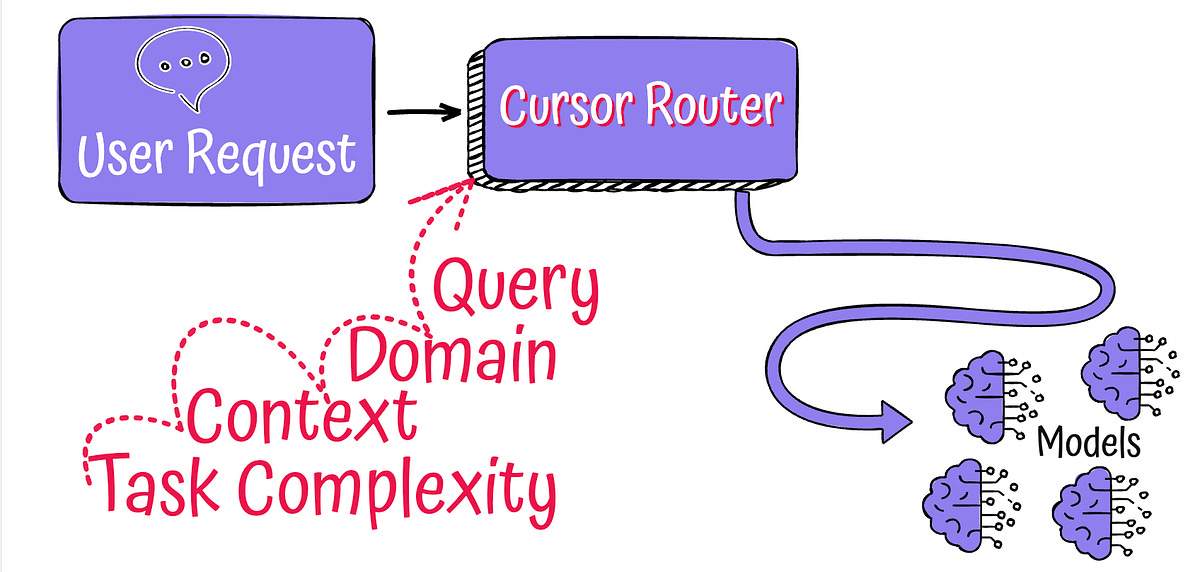
Cursor Router is a classifier that routes users to the best model option based on their query.
So the Cursor Router analyses each request on query, context, task complexity and domain, combined with what we know about each model’s behaviour.
Cursor categorised model according to price-efficiency, best taste in the case of design and UI…and complex, long-horizon problems are sent to frontier reasoning models.
The importance of model routing is important because models are shipped, deprecated, updated often.
The router is updated, and hence the experience just keeps improving.
Cursor Router has three modes: Intelligence, Balance, and Cost which let you adjust where you are on the cost-intelligence Pareto frontier.
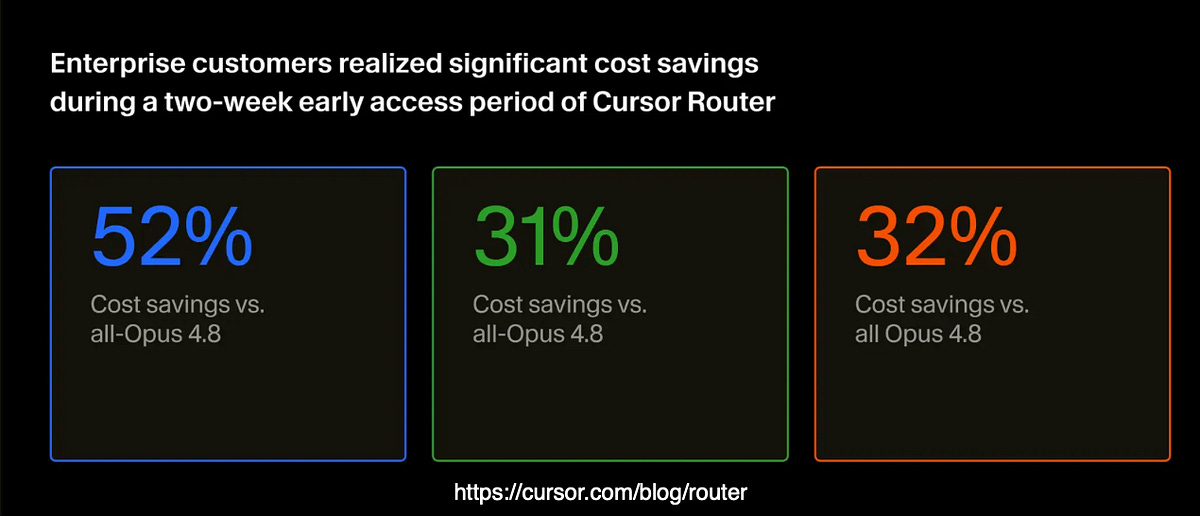
What I found interesting is that Cursor saw cost per request as only half the story. They also looked at the quality of shipped code and cost per commit.
For a single commit, they found that Cursor Router had a lower cost per commit of $6.76 for Intelligence mode and $4.63 for Balance.
The Proxy in Front of the Model Is Becoming the Intelligence Layer
For a while the model was the product…cobusgreyling.medium.com
The cost-per-commit receipts carry the argument further than capability charts: once the harness owns task-to-model matching, frontier performance at 30-50% lower cost arrives as a property of the layer, and every model underneath becomes a rented, swappable expert. The strategic half is jurisdiction. Whoever owns the routing layer owns the switching costs, so a vendor price move or a deprecation lands as a routing decision and a small config change; the migration project never happens. We took the same inversion to portfolio scale with 35+ models across 8 problem-solving archetypes, where the practitioner commands the routing layer and the measured payoff runs 40-60% cost reduction with 3-9% quality gain. https://seldondance.substack.com/p/the-maoe-gambit-own-your-ai-stack #ModelRouting #AISovereignty
The per-commit figures are the strongest part of the case, since $4.63 in Balance mode turns model choice into a line item a finance team can audit. The 60% single-model habit you cite is where the concentration risk sits: one vendor owns the daily-driver slot, so every price move and deprecation lands on the same workload. Treating task fit, cost, and reliability as separate asset classes makes allocation a rebalancing decision, and deprecations turn into scheduled portfolio events. The full portfolio treatment, usage percentages by project area included: https://seldondance.substack.com/p/the-multi-model-ai-strategy-that #ModelRouting #MultiModel