Loop Engineering Playbook
Where loops live, how to run your first one, and why Grok and Claude are not the only tech when it comes to Loop Engineering

If you read Loop Engineering, you already know the shift: stop prompting agents turn-by-turn, and start designing systems that prompt them for you.
I wanted to, with this blog, create a practical map of where loops live, which pattern to run first, how to roll out without burning tokens…and what to use when your loop outgrows a terminal session.
Loop Engineering
The core of Loop Engineeringcobusgreyling.medium.com
The conversation is dominated by Grok Build and Claude Code right now.
They deserve the attention. But a loop is a small control system, not a product logo. The primitives are transferable and the runtime you pick depends on how long the loop runs, who it serves, and what it is allowed to touch.
Now that AI agents are writing our code, is comprehension debt the new technical debt?
Where does the loop live?
A loop is not a prompt, it is a recurring process with memory, verification, and boundaries.
That process needs a home, somewhere to schedule the next run, persist state across sessions, isolate parallel work, and reach your real tools.
Think of three layers:
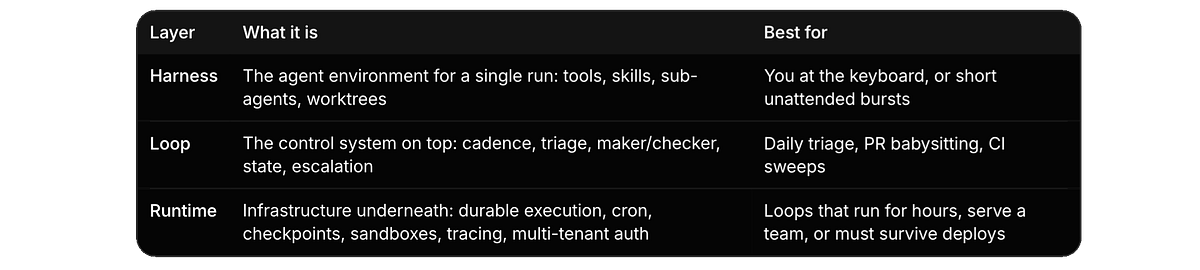
Grok and Claude Code are excellent harness + loop surfaces.
You get `/loop`, skills, sub-agents, worktrees, and MCP connectors in one place. For a solo engineer or a small team, that is often enough.
But the moment your loop needs to run at 3 a.m. while nobody has a terminal open, survive a process crash mid-run, pause for human approval for three days, or give every agent its own isolated machine, you are in runtime territory.
That is where LangChain has been building.
Every agent needs a computer ~ LangChain
I love LangChain’s recent framing, Give your agent its own computer, it lands directly on loop engineering.

The insight is simple, reasoning alone does not close the loop. An agent that can only suggest is not running a loop. An agent that can run code, observe the result, fix it, and run again is.
That feedback cycle…reason, act, observe, repeat…is the inner loop every outer loop depends on.
Coding agents in Grok and Claude Code already get this locally: they edit files, run tests, read stderr, iterate.
LangChain’s answer for production is different in where the computer lives:
LangSmith Sandboxes, hardware-isolated microVMs per agent (filesystem, shell, packages, network, persistent state), not shared containers on your laptop
Durable execution, check-pointed graph state so a twenty-minute run survives crashes and deploys
Cron on the Agent Server, scheduled runs with the same tracing and auth as interactive sessions
Human-in-the-loop interrupts, the loop pauses, frees resources, resumes days later from the exact checkpoint.
Read their runtime guide for production deep agents alongside your loop design. The vocabulary maps cleanly:
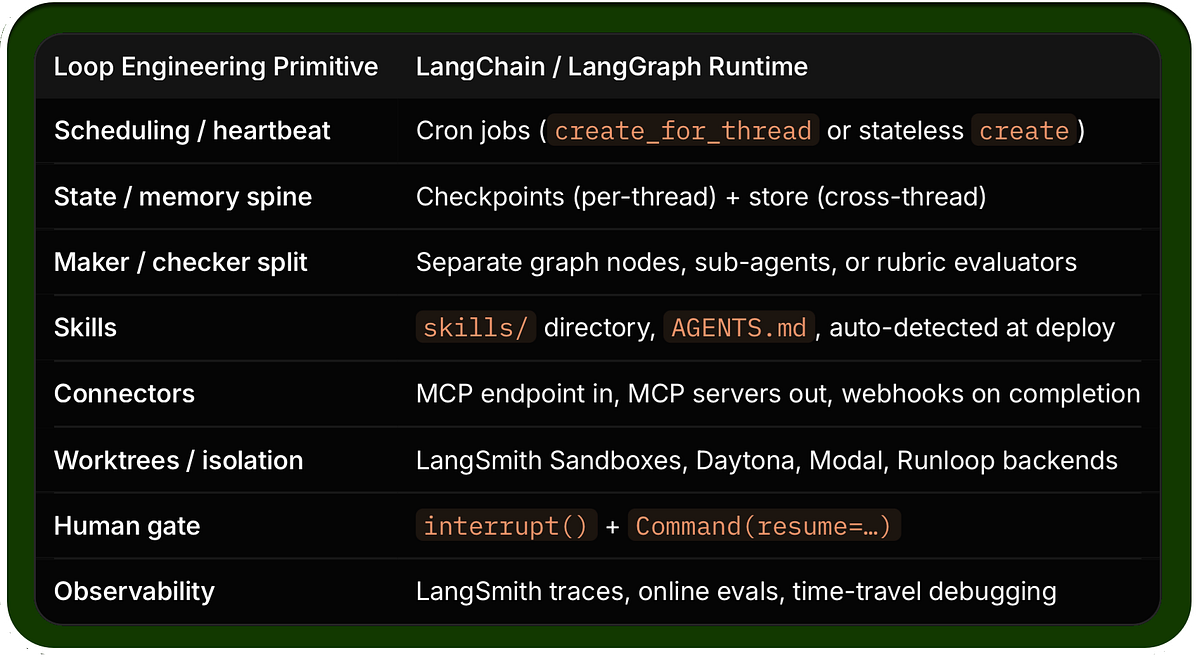
The LangChain stack is not a replacement for Grok or Claude Code.
It is what you reach for when the loop must live outside your/a machine, when “I have `/loop` running in a TUI” is not an acceptable production answer.
A CI agent that clones a repo, installs deps, runs the full suite, and opens a PR is exactly the workload LangChain describes. So is a nightly triage agent that builds on yesterday’s findings in the same thread.
So is a monitoring loop that fires every fifteen minutes and escalates only when state changes.
The sandbox tweet is not about chat UIs. It is about giving each iteration of the loop a safe place to *work* — which is the prerequisite for unattended operation.
The playbook in four moves
Grok and Claude Code are the fastest path for developer loops, loops owned by one engineer, scoped to repos they already work in, with a human nearby.
They are not the only options, so here is how the field breaks down.
Tier A: Terminal harness loops (best for solo / small team)
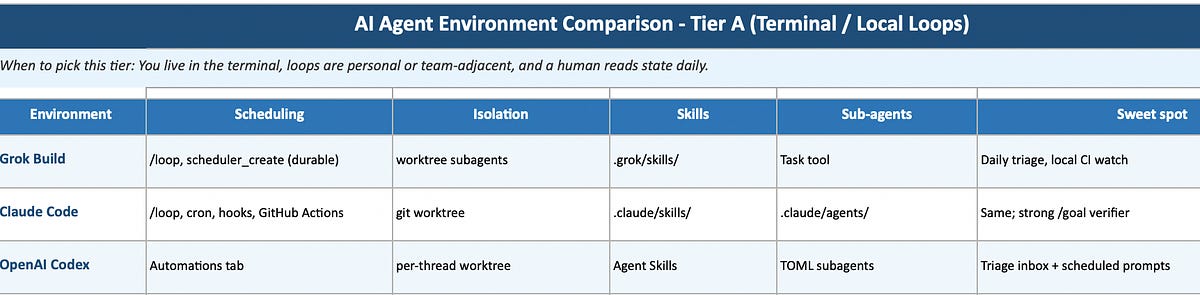
Tier B:Platform runtime loops (best for production / multi-tenant)
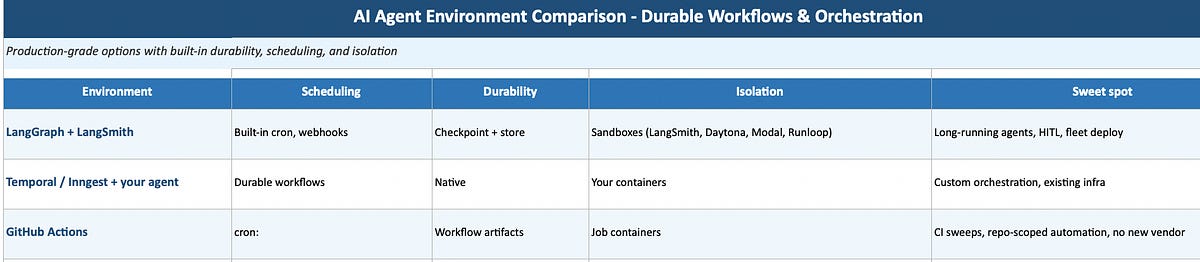
Pick this tier when the loop serves a product or a team, must survive restarts, needs audit trails, or runs code you did not write.
LangChain’s cron distinction is worth stealing even if you never deploy to LangSmith:
Stateful cron: same ‘thread_id’ every run; the agent remembers yesterday (nightly research, monitoring with history)
Stateless cron: fresh thread per run; batch triage, one-off sweeps.
That maps directly to “append to `STATE.md`” vs “read repo ad exit.”
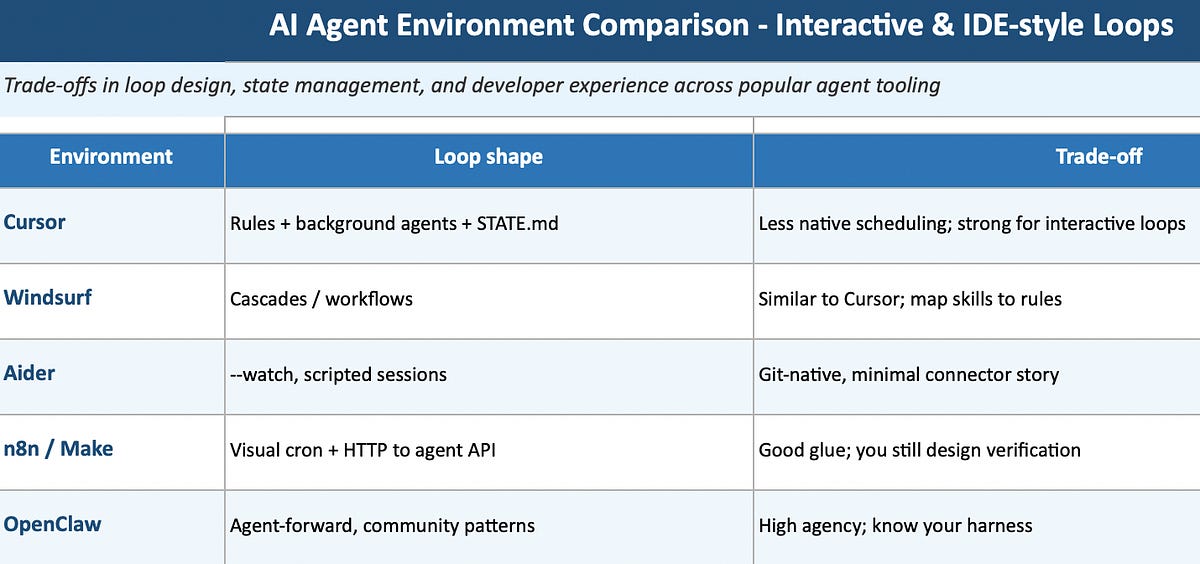
Tier C — Editor and lightweight alternatives
Pick this tier when you are already locked to an editor, or you want cron and webhooks without adopting a full agent platform.
Cost and safety defaults
Loops multiply cost fast. Defaults that keep you out of trouble:
Triage should be cheap, one model pass over signals, not implementer + verifier on every cron tick.
Spawn sub-agents only when state says actionable, aA 5-minute loop with full maker/checker on every run will burn a limited plan before breakfast.
Cap iterations per item, three attempts, then escalate to human.
Comprehension debt
Now that AI agents are writing our code, is comprehension debt the new technical debt?
Speed can mask the gap between what exists and what you understand.
The loop shipped the fix, that does not mean you know how it works.
Build the loop like someone who intends to stay the engineer and not just the person who presses go.
Addy Osmani said it plainly. So did Boris Cherny from inside Anthropic.
LangChain’s team says the same from the runtime side: traces tell you what happened, but someone still has to read them.
The comfortable trap is cognitive surrender, the loop is leverage, not a substitute for judgment.
Chief Evangelist @ Kore.ai | I’m passionate about exploring the intersection of AI and language. From Language Models, AI Agents to Agentic Applications, Development Frameworks & Data-Centric Productivity Tools, I share insights and ideas on how these technologies are shaping the future.
Loop Engineering
The core of Loop Engineeringcobusgreyling.medium.com
GitHub - cobusgreyling/loop-engineering: Practical reference and patterns for loop engineering …
Practical reference and patterns for loop engineering - designing systems that prompt and orchestrate AI coding agents…github.com
COBUS GREYLING - At the intersection of AI & Language
Cobus Greyling is an AI Evangelist & thought leader dedicated to exploring the intersection of artificial intelligence…www.cobusgreyling.com
Effective harnesses for long-running agents
Anthropic is an AI safety and research company that’s working to build reliable, interpretable, and steerable AI…www.anthropic.com