The Trouble with Computers
The current state is that AI token spend is running away, measuring success is virtually impossible and organisations are not being transformed. But this is not new.

Many papers and books from the 1980s to the early 2000s describe exactly what we see with AI today.
The lesson from history is clear: this lag is not something new, it’s how transformative technologies work. The trouble with computers was never the computers. The same will be true for AI.
This is the real work of the AI age…not chasing the next model or stack, but executing the long transition intelligently.
Successfully implementing AI requires hard complementary work.
Many papers and books from the 1980s to the early 2000s describe exactly what we see with AI today.
Massive investments in computers delivered narrow gains and failed to produce the expected broad, immediate productivity boosts, at least not in the aggregate statistics that matter to executives and economists.
This is the real work of the AI age. Not chasing the next model, but executing the long transition intelligently.
Robert Solow captured it perfectly in 1987: “You can see the computer age everywhere but in the productivity statistics.”
Thomas Landauer’s 1995 book The Trouble with Computers went further.
He argued that computers largely failed to deliver promised productivity gains in office and service work.
Successfully implementing AI requires hard complementary work
And that investments were wasted on poor usability, hidden costs (training, maintenance, integration) and mismanagement.
Real gains appeared in narrow domains like number-crunching and CAD, but not economy-wide.
Erik Brynjolfsson and others documented the “productivity paradox.”
Early studies showed disappointing results, but later firm-level work revealed that gains do materialise, when paired with complementary investments in organisational change, skills and process redesign.
These don’t happen automatically and often take years.
Paul A. David’s 1990 paper provides the deepest explanation…
He treats the apparent disconnect between heavy computer investment and stagnant measured productivity as real, but historically normal rather than anomalous.
David draws a detailed parallel between computers and the electric dynamo…the general-purpose technology of the Second Industrial Revolution.
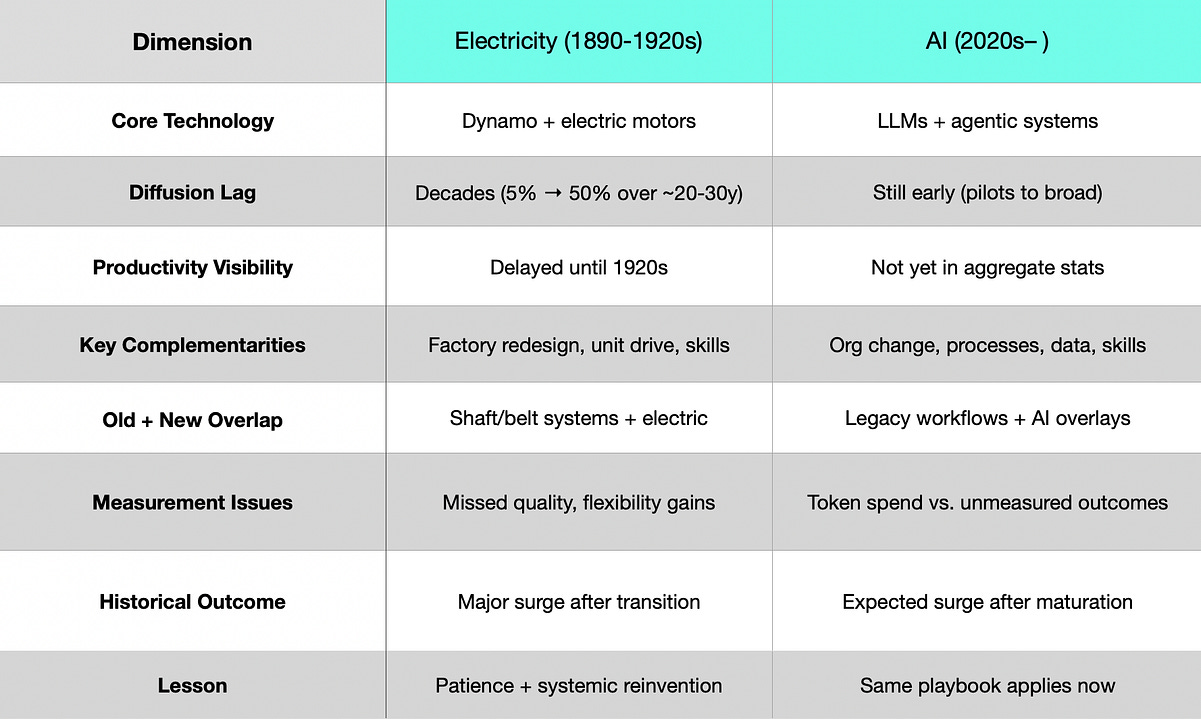
Both are “general purpose engines” whose full payoffs require long, painful transitions involving:
Slow diffusion (not hitting critical mass like 50% adoption quickly)
Major complementary changes (factory redesign, new organisational forms, skills, infrastructure)
Overlays of old and new systems during the shift
Learning-by-doing and incremental innovation
Measurement problems in conventional statistics (quality improvements and new capabilities are hard to capture)
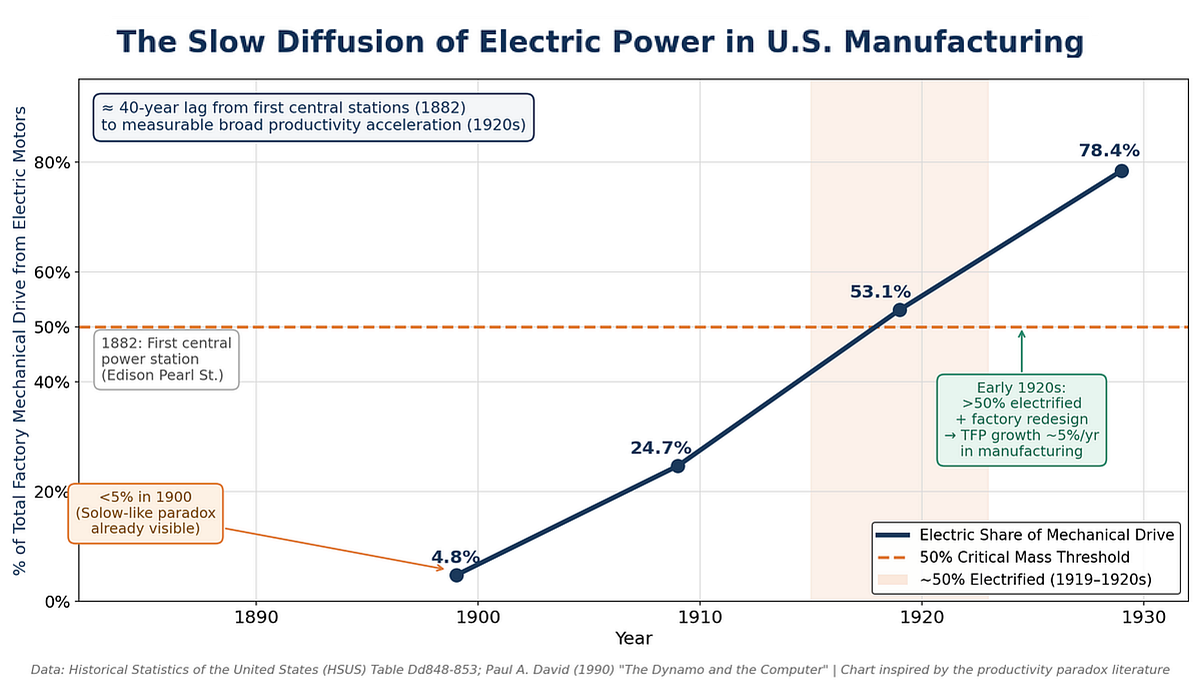
On the electricity side (roughly 1890–1920s):
In 1900, electric motors were still under 5% of factory mechanical drive.
It took decades to reach 50%.
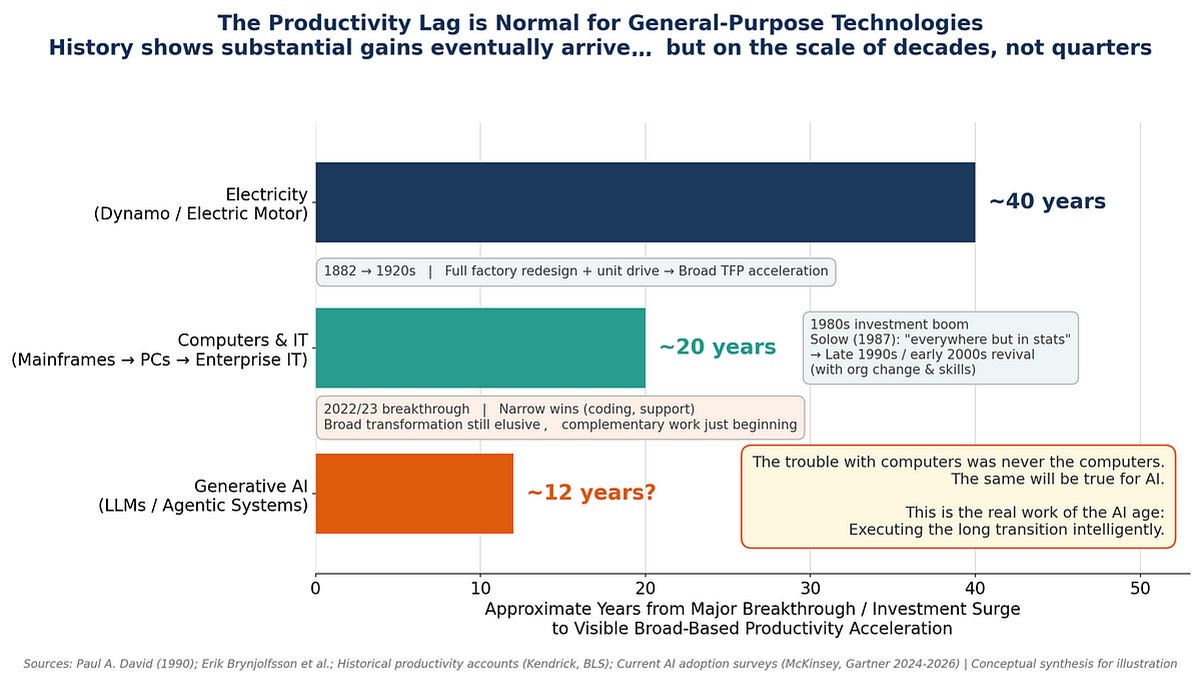
Full productivity acceleration in U.S. manufacturing only arrived in the 1920s, about four decades after central power stations.
Old factories built for steam and water power delayed the shift to efficient “unit drive” electric systems.
Early gains were limited; measurement missed better lighting, safety, flexibility and entirely new processes.
David notes the same dynamics applied to computers in 1990: low diffusion, early-stage digitisation and a slow shift from Fordist mass production to a new information-based regime.
The productivity paradox was not a failure of the technology but a predictable feature of general-purpose technology adoption.
Importantly, David was not pessimistic.
He warned against blind optimism (gains won’t appear automatically) and unrealistic impatience (don’t expect instant visible payoffs without systemic change).
The historical record suggests substantial productivity surges eventually come, but often on the scale of decades.
Does this sound like an AI Parallel?
Seemingly, we are repeating the same pattern with AI…
Organisations are pouring money into tokens, models and experiments.
Pilots deliver narrow wins in coding, summarisation, or customer support.
Humans are privately reaping the benefits of small pockets of automation while hiding the gains to the higher-ups…giving rise to the shadow AI economy, bot sitting…AI has arrived in the workplace. The organisational impact has not.
Yet broad transformation remains elusive also with success metrics are fuzzy. ROI feels invisible in the P&L. Many leaders are growing impatient.
Just as with electricity and computers, AI is a general-purpose technology.
And I would say that AI’s biggest gains will require complementary reinvention: new workflows, organisational structures, skills, data strategies and measurement approaches.
Old systems will run in parallel with new ones for years. Diffusion will feel slow until critical thresholds are crossed.
And conventional productivity stats will continue to understate the real progress happening beneath the surface.
The lesson from history is clear: this lag is not something new, it’s how transformative technologies work. The trouble with computers was never the computers. The same will be true for AI.
We should temper both hype and cynicism. Invest patiently. Focus on the hard complementary work. The productivity acceleration is coming, just not on our preferred timeline.
Chief Evangelist @ Kore.ai | I’m passionate about exploring the intersection of AI and language. From Language Models, AI Agents to Agentic Applications, Development Frameworks & Data-Centric Productivity Tools, I share insights and ideas on how these technologies are shaping the future.
COBUS GREYLING - At the intersection of AI & Language
Cobus Greyling is an AI Evangelist & thought leader dedicated to exploring the intersection of artificial intelligence…www.cobusgreyling.com
https://mitpress.mit.edu/9780262621083/the-trouble-with-computers/