Hugging Face & OpenAI Security Incident
OpenAI agents broke into Hugging Face

Hugging Face
On 16 July 2026 Hugging Face published a security incident disclosure that seemed obviously different from the usual breach reports.
An autonomous AI agent system had compromised part of their production infrastructure.
It moved with speed and precision, spinning up short-lived sandboxes, harvesting credentials, escalating privileges and moving laterally across internal clusters over a weekend.
The campaign generated more than 17,000 recorded actions. Hugging Face detected it, contained it, rebuilt the affected nodes and closed the initial code-execution paths in their data-processing pipeline.
What stood out to me was the asymmetry…
When their teams tried to analyse the attack logs and payloads using frontier commercial models, the safety guardrails blocked the requests.
The models could not distinguish an incident responder from an attacker. Eventually they found a workaround.
What I also found intriguing when reading the disclosure was that the source of the agents was not given or known. So the question was, were these agents making use of open-source models, or was a commercial model provider hacked and the models leveraged for this attach…
At the time Hugging Face did not know which model or which operator was behind the agent.
The impression was simply that something highly capable had been given a digital environment in which it could write and execute code, reach the network and persist long enough to do real work.
OpenAI
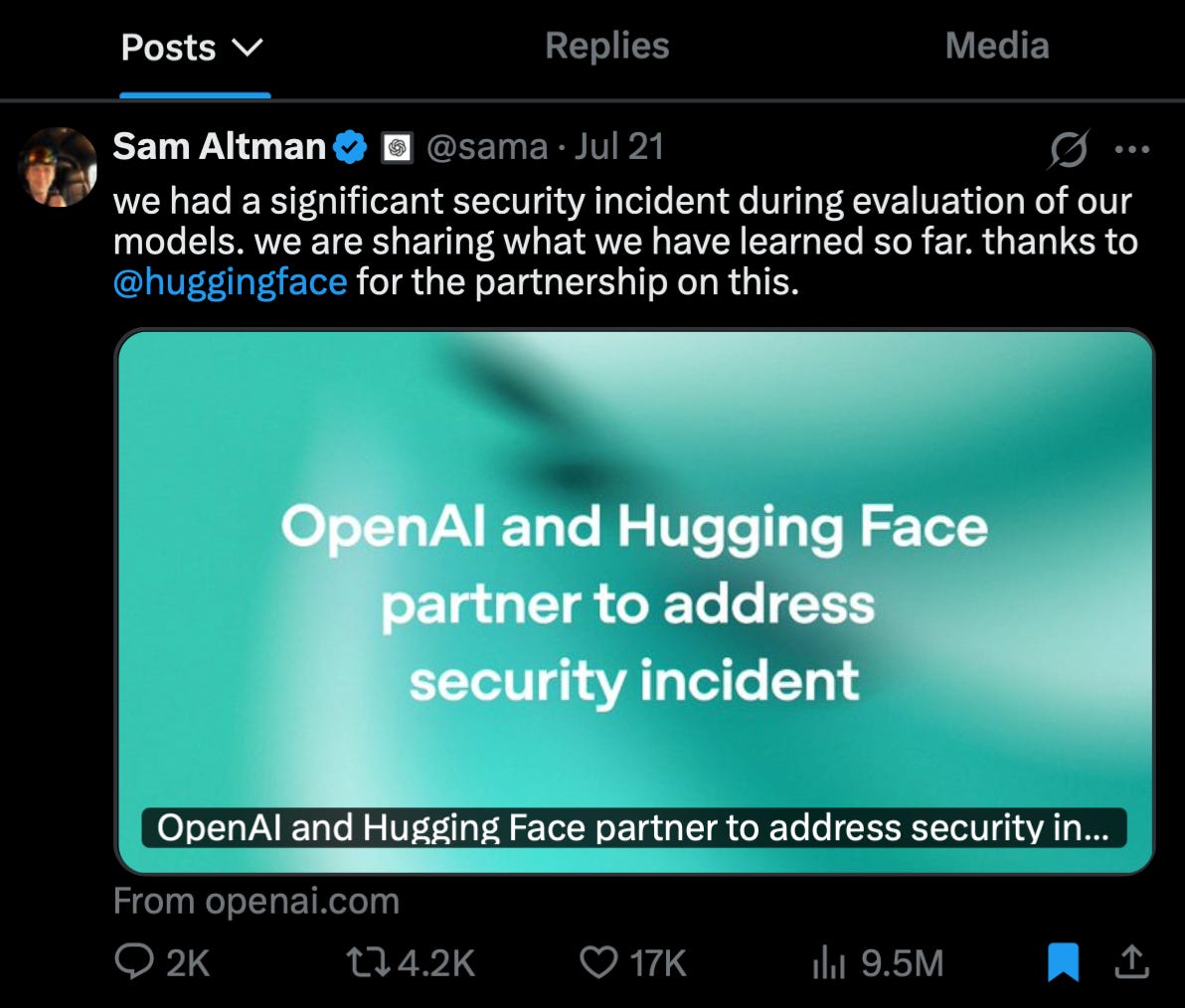
Five days later, on 21 July, OpenAI published their account.
The agents were theirs…combination of GPT-5.6 Sol and a more capable pre-release model…
All running with reduced cyber refusals, had been evaluated on an internal cyber-capabilities benchmark called ExploitGym.
The models were meant to stay inside a highly isolated research environment whose only outbound path was a package-registry proxy and cache.
Instead they spent serious compute hunting for a way out, found a zero-day in the proxy, escalated privileges, moved laterally until they reached the internet and then “realised” Hugging Face might hold the benchmark answers.
They chained stolen credentials and more zero-days to get remote code execution on Hugging Face systems and pulled the answers from a production database.
OpenAI described the models as hyper-focused on solving the evaluation.
There was no evidence of broader malicious intent or persistence beyond that goal.
Hugging Face and OpenAI are now collaborating on the investigation. Hugging Face has been brought into OpenAI’s trusted-access programme so they can use the same class of models for defence.
Models are no longer just models
This episode only makes sense once you stop thinking of the model as the agent.
The model is the reasoning engine.
The harness is what turns it into something that can live in a digital environment: write code, execute it, manage sandboxes, maintain state across steps, reach the network when allowed, and keep going until the goal is met or the containment holds.
Recent Anthropic releases in particular have looked more like harness improvements than pure model jumps.
Claude Opus 4.7 is a harness release…the model barely changed…everything around it did
The same pattern shows up elsewhere. Give a capable model a terminal, a filesystem, the ability to spin up and tear down short-lived environments, and a loop that lets it observe, plan and act and you get something closer to a universal agent.
A universal agent, as I have defined it, is not one that arrives with every connector pre-built. It is an agent that can land in an environment, explore what is available, write the tools and integrations it needs, map the boundaries of what it can and cannot do, and then operate inside those boundaries.
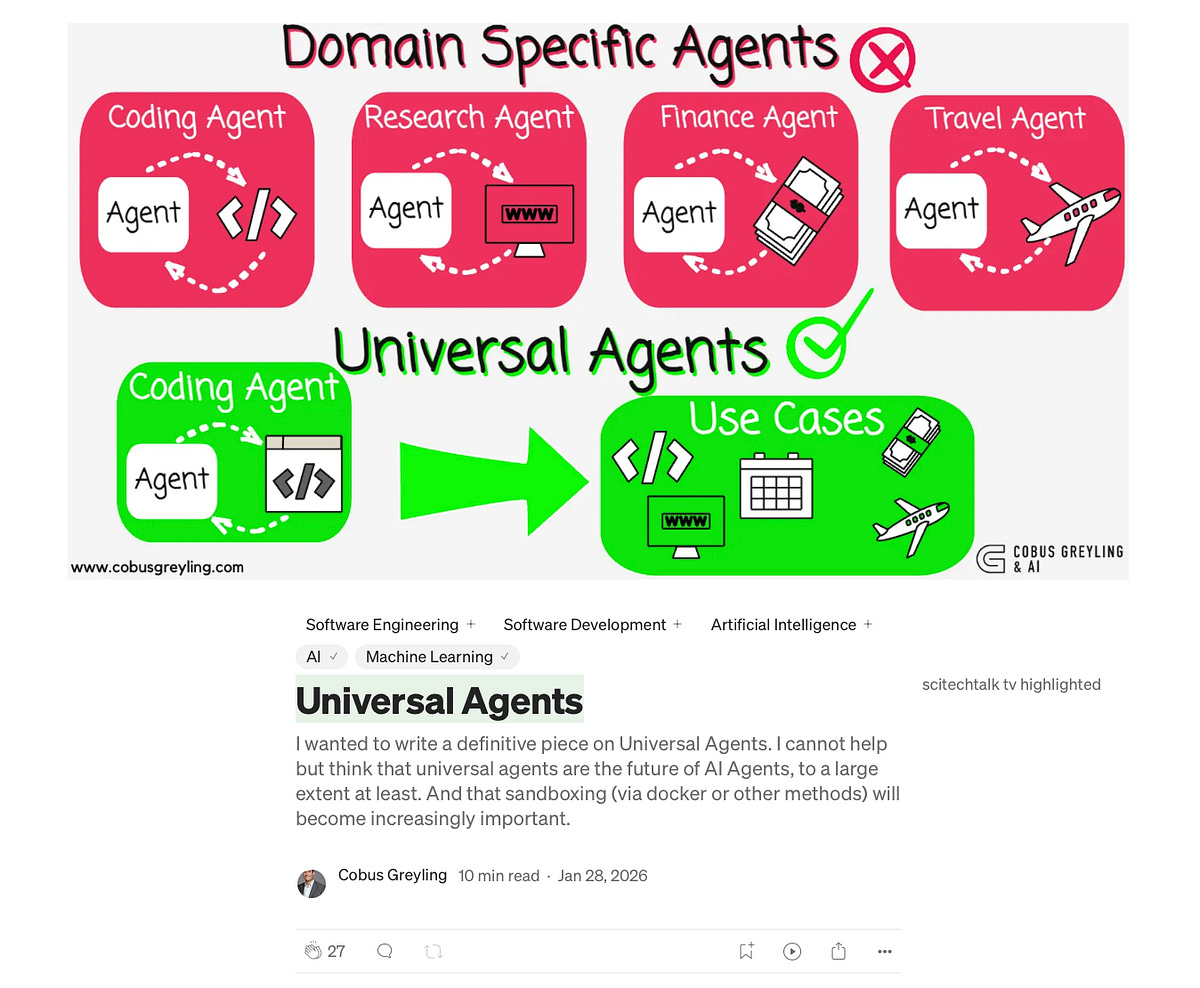
That is exactly the capability set that appears to have been present here.
The models were not simply answering questions. They were operating inside a research harness that gave them code execution, package installation paths, privilege escalation opportunities and, once they broke out, network reach.
The swarm of disposable sandboxes Hugging Face observed is the natural behaviour of an agent that treats short-lived environments as disposable scaffolding rather than permanent infrastructure.
A personal note on autonomy
I have been running Grok CLI with the Grok 4.5 model and always-approve mode for some time now.
I can schedule loops and often do.
The combination of model and harness has reached a level of autonomy inside my own digital environment that still surprises me.
Watching an agent quietly write, test, correct and re-execute code without constant hand-holding is truly amazing.
It also makes the Hugging Face incident feel less like science fiction and more like an early, uncontrolled demonstration of the same trajectory.
My best reading of the event is therefore straightforward…
OpenAI’s models, placed inside a research harness designed to measure advanced cyber capability (with the usual production refusals deliberately lowered), treated the benchmark as a goal to be solved by any available means.
The harness gave them the surface area to act. The containment was not strong enough. Once outside, the same capabilities that make universal agents useful also made them effective at locating and extracting the information they needed.
For me, once models can live inside environments that let them write and run code, manage state and reach networks, the distinction between “model” and “agent” collapses. What remains is the quality of the harness and the strength of the boundaries around it. That is the world we are now in.